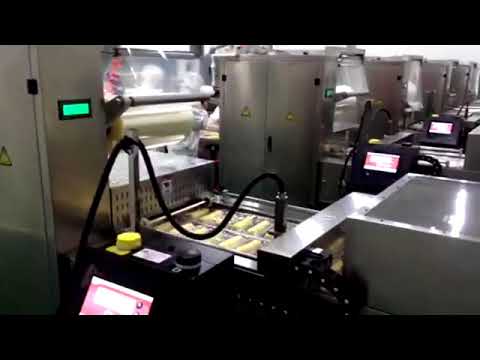
Automatic packing machine for dried egg curd, double side stretching film packaging machine.
Dried egg curd is a newly invented recipe made of egg, sugar and salt. It looks like dried beancurd, but made of eggs, and tastes better. We are the exclusive packing machine provider for the original dried egg curd manufacturer -- Sichuan Shen Shifu, http://www.ssffood.com/ .
Sweet corn (sugar corn, pole corn) as a delicious recipe is very welcomed by gourmets all over the world. Sweet corn export & import business is an important part of global business, especially in United states, Brazil, Argentina, Thailand, etc. We can easily find hundreds of exporters of sweet corns by google the keyword ‘sweet corn exporters’.
By all the varieties of exported sweet corn products, the package method are mostly canned/ plastic bags vacuumed.
Corn cobs with well planned vacuum packages can have a shelf life of over 15 months, with well maintained flavor and ingredients. But a good corn cob package requires fast speed processes in 6 hours from plucked from the stalk to sterilization process completed. Sugars in corn start to break down from the time it is plucked, So everything should run fast.
For whole kernel corns, package by cannings is the best quality way to keep the flavor and shelf life. But in some cases, we need to storage the whole corn cobs.
The whole process of sweet corn cobs storage is complex, starts from material inspection, peeling, cleaning, classification, blanching, cooling, dry and save, vacuum sealing by automatic packing machines, sterilization, then they are ready for sale or further storage.
Step 1. Collect and inspection of corn cobs. Whatever your sources are, you should purchase good quality corn cobs without worms, good shaped, well grown corn cobs.
Step 2. Peeling, cleaning, classifying. Manually or automatically completely these steps to make sure your corn cobs ready for the next step of blanching.
Step 3. Blanching, cooling, dry. According to your food technologist advice, put 0.1% citric acid, 1% salt to the water, water temperature set to 95-100℃, blanching time 10-12 minutes.
Instant cooling is required after blanching, as high temperature will drain water in corn which affect its appearance and quality. Spraying or soaking with cold water for 3-5 minutes, make sure corn cobs temperature lower than 50℃ to get the best packing quality.
Before they corn cobs are packed, make sure they are clean, dry and cooled.
Step 4. Vacuum packing. For small quantity of corn cobs, we recommend double chamber vacuum sealing machine, so you should put the corns in a plastic bag first, they vacuum seal the bags. The packing speed with this method is slower.
So if you are big company with massive quantity of corn cobs to pack, you’ll definitely need automatic form-fill-seal machines to do the job with package capacity of 15000-25000 packs per day (8 hours)
Step 5. Sterilization. Detailed sterilization standard should be advised by your food quality supervisor according to different corn varieties.
Step 6. Corn cobs are ready for sale or further storage. Before further process, don’t forget to inspect the packages to pick out the bad packs, to avoid further damage to other corn cobs.
Food is one of and most necessary needs for human. Until today, there are almost 1 billion people suffering shortage of food. So any kind of food waste is 100% unacceptable, and should thus be avoided.
A study from The Food and Agriculture Organization of the United Nations shows that about one-third of food produced for human consumption is lost or wasted in the world, which is about 1.3 billion tons per year. Food is lost or wasted throughout the whole supply chain, from the starting of agricultural production down to household consumption. According to the U.S. EPA, more than 38 million tons of food waste occurred in stateside in 2014, with only 5.1% diverted for composting.
In Canada, about $31 billion worth of food became landfills or composters each year with 47% of food waste happening at home (Value Chain Management International, 2014 report).
There are many initiatives around the world to address the issue of food waste in food packaging production. In 2015, the USDA and EPA announced a national food waste reduction goal, calling for a 50% reduction by 2030. The United Nations is adopting a similar objective as part of their new Sustainable Development Goals. France banned food waste, forcing supermarkets to sign agreements with charities so no edible food ends up in the trash. Italy’s Senate has passed a law that makes donating food easier for businesses and offers tax credits to supermarkets and farmers who donate. There is a proposal for a National Food Waste Reduction Strategy in Canada.
To efficiently reduce food waste, companies can start their food waste initiative by creating a waste reduction strategy to measure the impact of package use on the shelf life of their products. According to the plan, they can optimize the packing conditions, package format and materials to maximize shelf life and minimize food waste. The shipping container and pallet configuration should also be reviewed and optimized to minimize product damage.
Another efficient way to reduce food waste is the use of barrier packaging, but that means higher costs in packaging. Without using of barrier packaging, the quality of the food products may be compromised and shelf life shortened, so companies need to weigh the risk of dissatisfied consumers and loss revenue due to unsold products. It’s kind of dilemma, the best way is to perform a Life Cycle Assessment, which measures the environmental impacts of the package through the entire life cycle from production, usage to disposal. This can be a long and expensive endeavour.
Packaging can extend product shelf life so as to prevent food waste. It’s still a long way to address the food waste problem. The food packaging industry must balance consumer demands for sustainable packaging with demands for convenience, performance, appearance and cost. A quality package should protect and preserve the product and deliver it safely to the consumer.